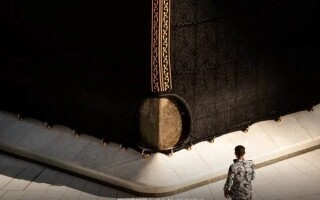
The Shadrawan is one of the prominent architectural landmarks surrounding the Kaaba in the Grand Mosque. It wraps around the base of the Kaaba's wall, forming a significant part of its historical and structural engineering, along with the architectural and functional meanings it carries that contribute to protecting the foundations of the ancient house and enhancing its durability across the ages. The Shadrawan is represented as a sloped stone frieze that slightly protrudes from the Kaaba's wall at its base from the Mataf level. It is known as the part of the Sacred House's foundation left exposed, and is also called an 'Az-Zirwar' because it resembles an Izar (lower garment) that wraps around the building's base. The Shadrawan takes the form of a notched marble cornice surrounding the lower part of the Kaaba's wall from three sides, while it is absent on the side of the Stone of Ishmael due to historical construction differences in that area, and it also disappears at the location of the Kaaba's door. The Shadrawan consists of polished marble that has been carefully installed, and it features rings to which the Kaaba's Kiswah (cover) is tied for fastening, which reflects the precision in caring for the architectural details related to the Sacred House. This architectural element was designed in a way that helps protect the Kaaba's foundations from the effects of rainwater and floods that Makkah Al-Mukarramah was exposed to throughout history, in addition to its role in strengthening the wall's base and maintaining the building's stability. Furthermore, the Shadrawan contributes to organizing the movement of Tawaf (circumambulation) around the Kaaba, as it forms an architectural barrier that prevents direct contact with the wall's base during Tawaf, which enhances the building's safety and preserves its durability over time. The Shadrawan's structure has been rebuilt several times throughout history as part of the Kaaba's renovation and care works. Historical sources indicate its renewal in multiple years, including 542 AH, 636 AH, 660 AH, 670 AH, and 1010 AH, in addition to other maintenance works the Kaaba witnessed in different periods. In the modern era, the Shadrawan has received special attention within projects for the renovation of the Kaaba. Its marble was renewed during the era of the Custodian of the Two Holy Mosques King Salman bin Abdulaziz Al Saud, using new marble that mimics the color and quality of the old marble, while preserving some of the historical marbles existing below the Kaaba's door, which are considered precious artifacts that have maintained their quality and durability across time. The Shadrawan represents a prominent architectural witness to the continuous care for the Kaaba throughout the ages, as it combines both engineering function and architectural beauty, remaining an original element in the ancient house's architecture and a landmark that attracts the attention of pilgrims and visitors to the Grand Mosque from all over the world.